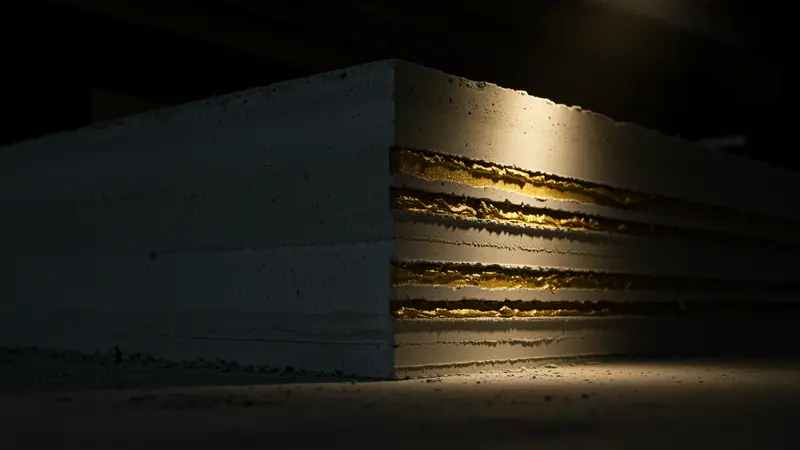

Interlayer open time is the variable most often missing from a print record, and the first thing a structural reviewer asks for.
A cold joint forms when the gap between depositing one layer and the next lets the lower layer stiffen past the point where the incoming material can bond into it. The new layer sits on a crust instead of keying into a plastic substrate.
What is actually happening
Two processes run in parallel once a bead is placed. The surface loses moisture to the air, and the mix rebuilds structure through thixotropy. Both make the surface less receptive. Beyond a certain point the interface stops being a bond and becomes a contact.
- Reduced interlayer bond strength at the affected joint
- Porosity concentrated at the interface rather than distributed
- A preferential plane for cracking under load or restraint
- In severe cases, visible layer splitting or delamination
Why geometry drives it
Cycle time is a function of path length. A small test wall returns to the same point quickly. A long or complex geometry can take several times as long, and the open time at any given point grows with it. Teams that validated a mix on a sample panel are frequently surprised when the same mix fails on a full structure.
The mix did not change. The time between layers did.
What to record
The single most useful thing a team can add to its print record costs nothing: a timestamp per layer, per location. From that you can derive actual open time and compare it against the threshold your mix was qualified to.
Whether an existing joint can be remediated depends on where it sits and what the wall is carrying. That is a question for a field audit and a structural review, not a general rule.
References
Standards, code provisions and peer-reviewed work this article rests on. Designations are given in full so a reviewer can pull the source themselves.
Sanjayan et al. (2018)Peer-reviewed
Effect of surface moisture on inter-layer strength of 3D printed concrete
Identifies surface moisture at the interface as a controlling variable for interlayer strength.
Le et al. (2012)Peer-reviewed
Hardened properties of high-performance printing concrete
Early and still widely cited measurement of how the delay between layers changes hardened bond strength.
Roussel (2018)Peer-reviewed
Rheological requirements for printable concretes
Sets out the yield stress, structuration rate and buckling limits that decide whether a mix can be printed at all.
ISO/ASTM 52939:2023Standard
The process standard: qualification principles, traceability and operational parameters for an additive construction site.
Citing a standard is not the same as certifying compliance with it. Nothing here is engineering certification, legal advice or a code approval.
Facing this on a live project?
Submit an Intake