
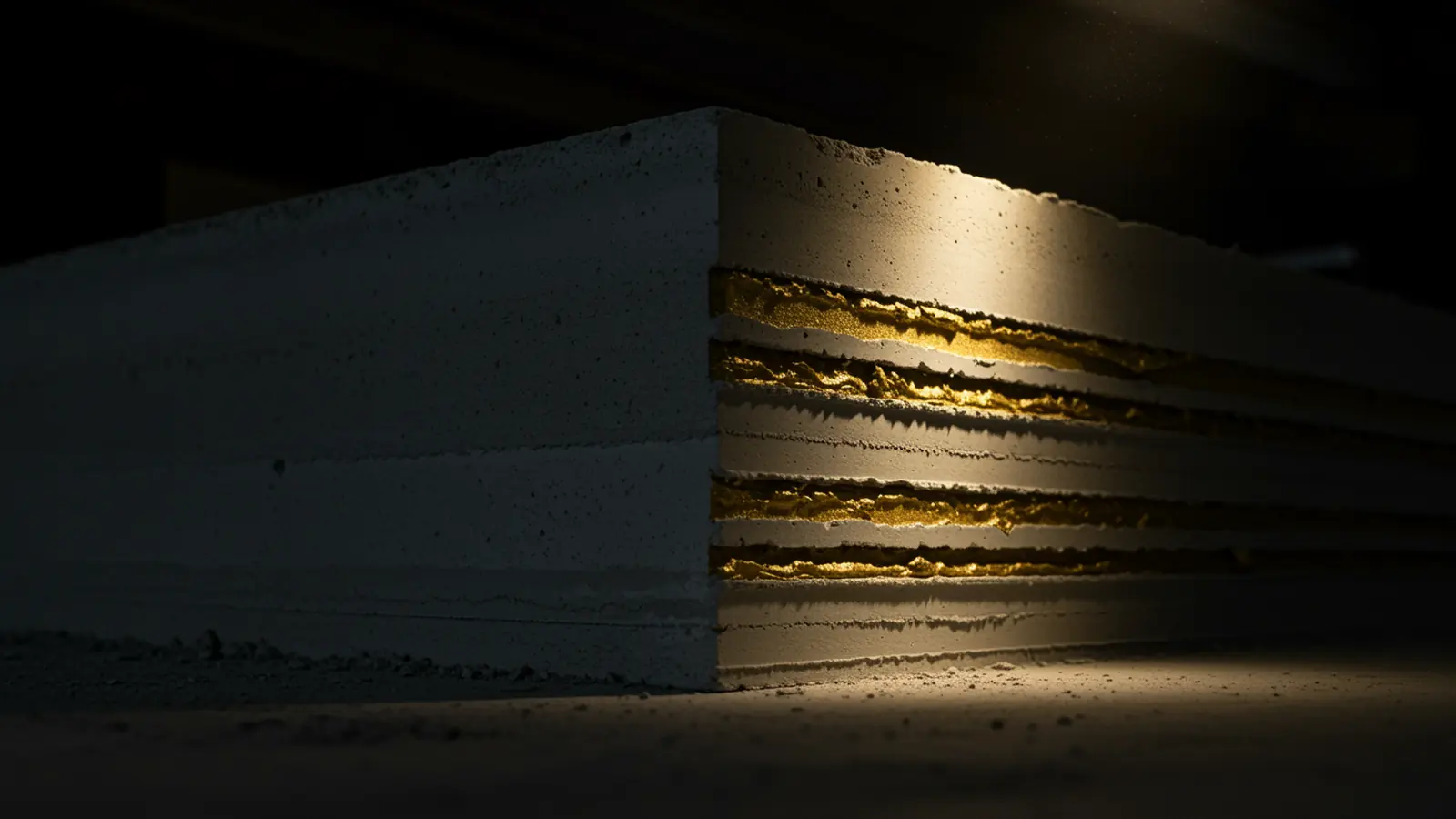
Bond at the interface is the property that distinguishes a printed wall from a stack of beads. Four variables move it more than the rest.
A printed wall is only structurally monolithic to the extent its layers bond. Everything else about the mix can be right and the wall can still behave as a stack if the interfaces are weak.
The four that matter
- Interlayer open time, which sets how much the lower surface has changed before the next bead arrives
- Surface moisture at the moment of deposition, driven by ambient conditions and wind exposure
- Thixotropic rebuild rate, which is a property of the mix and determines how quickly it stiffens at rest
- Extrusion pressure and nozzle standoff, which govern how much the incoming bead is pressed into the substrate
The fourth is the one teams most often have direct control over on the day. Increasing the mechanical action at the interface can partially compensate for a longer open time, within limits.
Testing what you are relying on
Bond strength claims should be tied to specimens produced under the conditions the wall was actually printed in, not to laboratory specimens made at ideal cycle times. That difference is the source of a large share of the discrepancies we see between qualification data and field cores.
References
Standards, code provisions and peer-reviewed work this article rests on. Designations are given in full so a reviewer can pull the source themselves.
Sanjayan et al. (2018)Peer-reviewed
Effect of surface moisture on inter-layer strength of 3D printed concrete
Identifies surface moisture at the interface as a controlling variable for interlayer strength.
Le et al. (2012)Peer-reviewed
Hardened properties of high-performance printing concrete
Early and still widely cited measurement of how the delay between layers changes hardened bond strength.
Mechtcherine et al. (2020)Peer-reviewed
Covers the full chain from mixing and pumping to deposition, and where each step can fail.
Roussel (2018)Peer-reviewed
Rheological requirements for printable concretes
Sets out the yield stress, structuration rate and buckling limits that decide whether a mix can be printed at all.
Citing a standard is not the same as certifying compliance with it. Nothing here is engineering certification, legal advice or a code approval.
Facing this on a live project?
Submit an Intake