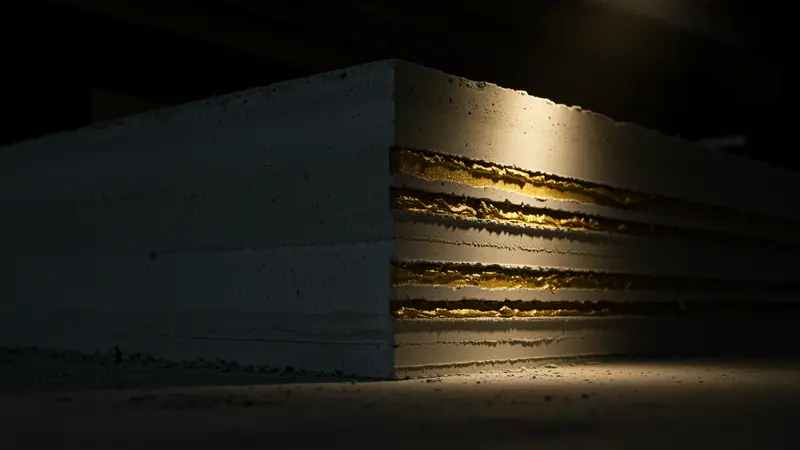

The property that lets a printed wall hold its own weight is the same one that closes your bonding window. It cannot be optimised in one direction.
Thixotropy is why the material flows under pump pressure and then holds its shape the moment it is placed. Without it there is no buildability and the wall slumps. With too much of it, the surface becomes unreceptive before the next layer arrives.
The property that makes the wall stand up is the property that stops it bonding. You are always trading between them.
What pushes it out of balance
- Accelerator dosing tuned for buildability on a small geometry, then carried onto a large one
- Ambient temperature above the range the mix was qualified in
- Aggregate substitution, which changes rebuild behaviour more than most teams expect
- Extended residence time in the delivery line before placement
Where local aggregate comes in
Local aggregate optimisation is one of the highest leverage areas in this sector, and one of the least transferable. A mix qualified on one source can behave differently on another that meets the same nominal specification. This is a materials science question, not a procurement one.
References
Standards, code provisions and peer-reviewed work this article rests on. Designations are given in full so a reviewer can pull the source themselves.
Roussel (2006)Peer-reviewed
A thixotropy model for fresh fluid concretes: Theory, validation and applications
The structural build-up model underlying how a mix stiffens at rest between layers.
Roussel (2018)Peer-reviewed
Rheological requirements for printable concretes
Sets out the yield stress, structuration rate and buckling limits that decide whether a mix can be printed at all.
Mechtcherine et al. (2020)Peer-reviewed
Covers the full chain from mixing and pumping to deposition, and where each step can fail.
Citing a standard is not the same as certifying compliance with it. Nothing here is engineering certification, legal advice or a code approval.
Facing this on a live project?
Submit an Intake